How to read a prediction market: Polymarket order books, odds and rules explained
How to read a prediction market before you bet: what share prices mean, how order books work, 99¢ vs 1¢ trades, and the rules that decide who gets paid
By Predxy
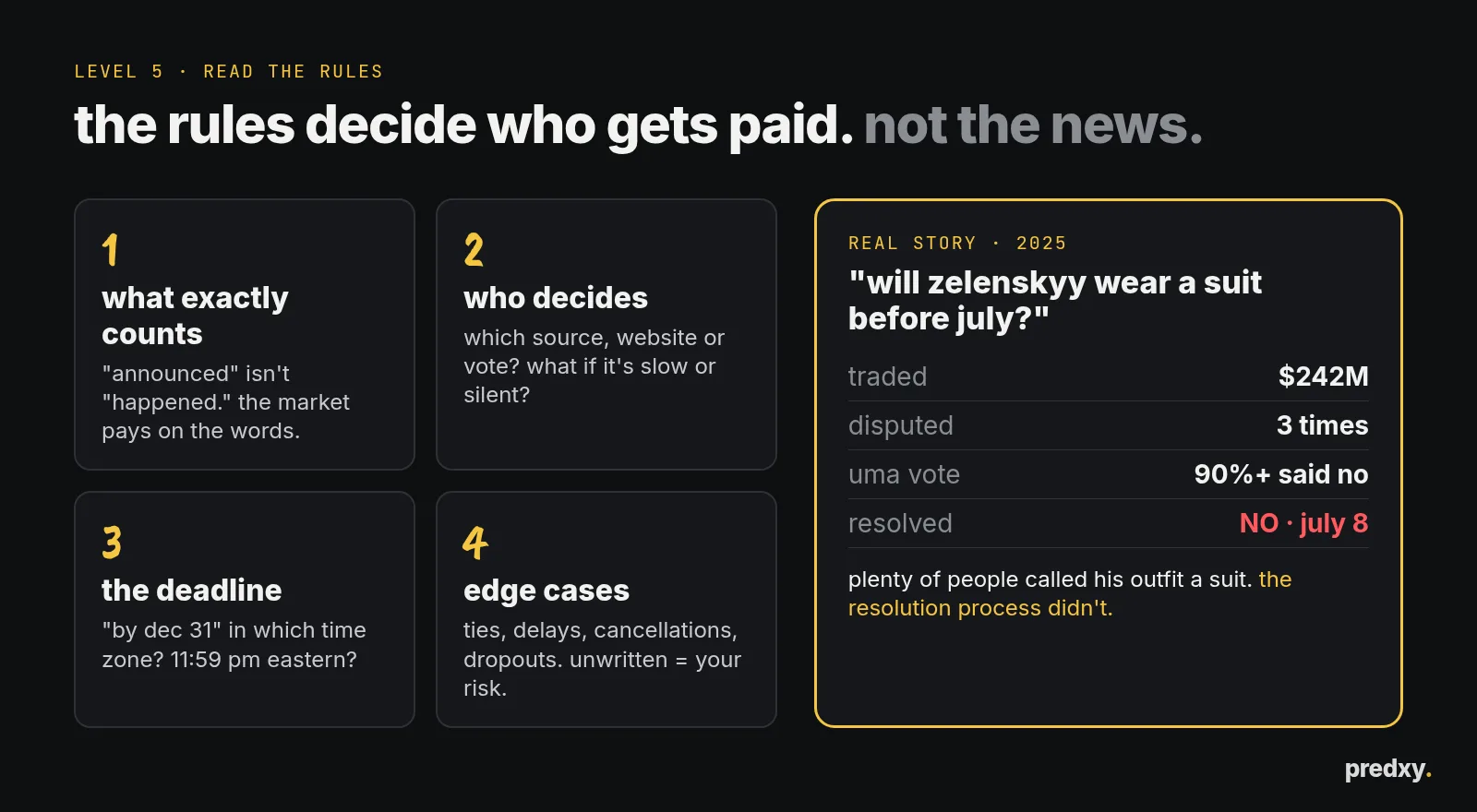
In 2025, $242 million was traded on one Polymarket question: will Zelenskyy wear a suit before July?
At the NATO summit on June 24, 2025, he showed up in a black jacket and matching trousers. A lot of people said that's a suit.
The market resolved no.
It was disputed three times and settled on July 8, 2025. We'll get to exactly why further down.
The people on the losing side weren't dumb. Many of them had a fair point. They just didn't read the thing that decides who gets paid.
That's the whole lesson of prediction markets: being right about the world is step one. There are about five more.
This is the guide we'd hand anyone opening Polymarket or Kalshi for the first time. It starts at zero, explains every term, and goes deep enough that people who trade every day will find something.
What's inside:
- What a prediction market share is, and what the price means
- How to read an order book
- Volume, open interest and the price chart
- 99¢ bets and 0.1¢ longshots
- How markets resolve, and why the rules matter most
- Why the same question has different prices on different apps
- A pre-trade checklist you can save
All trade examples use made-up numbers to show the math, unless we say a story is real.
What is a prediction market share?
A share is a ticket that pays $1 or nothing
Every market is a question. The simple ones are yes or no.
"Will it rain in London tomorrow?"
You buy a yes share or a no share. Think of it as a ticket that only cashes if you guessed right.
- It rains → every yes ticket pays $1. No tickets pay $0.
- It doesn't → every no ticket pays $1. Yes tickets pay $0.
One ticket, one dollar, if you're right. That's the whole product.
What do the prices on Polymarket mean?
Because a winning ticket is worth exactly $1, its price in cents works like a percentage.
- Yes at 62¢ = the crowd thinks it's about a 62% chance.
- No at 38¢ = about 38% it won't.
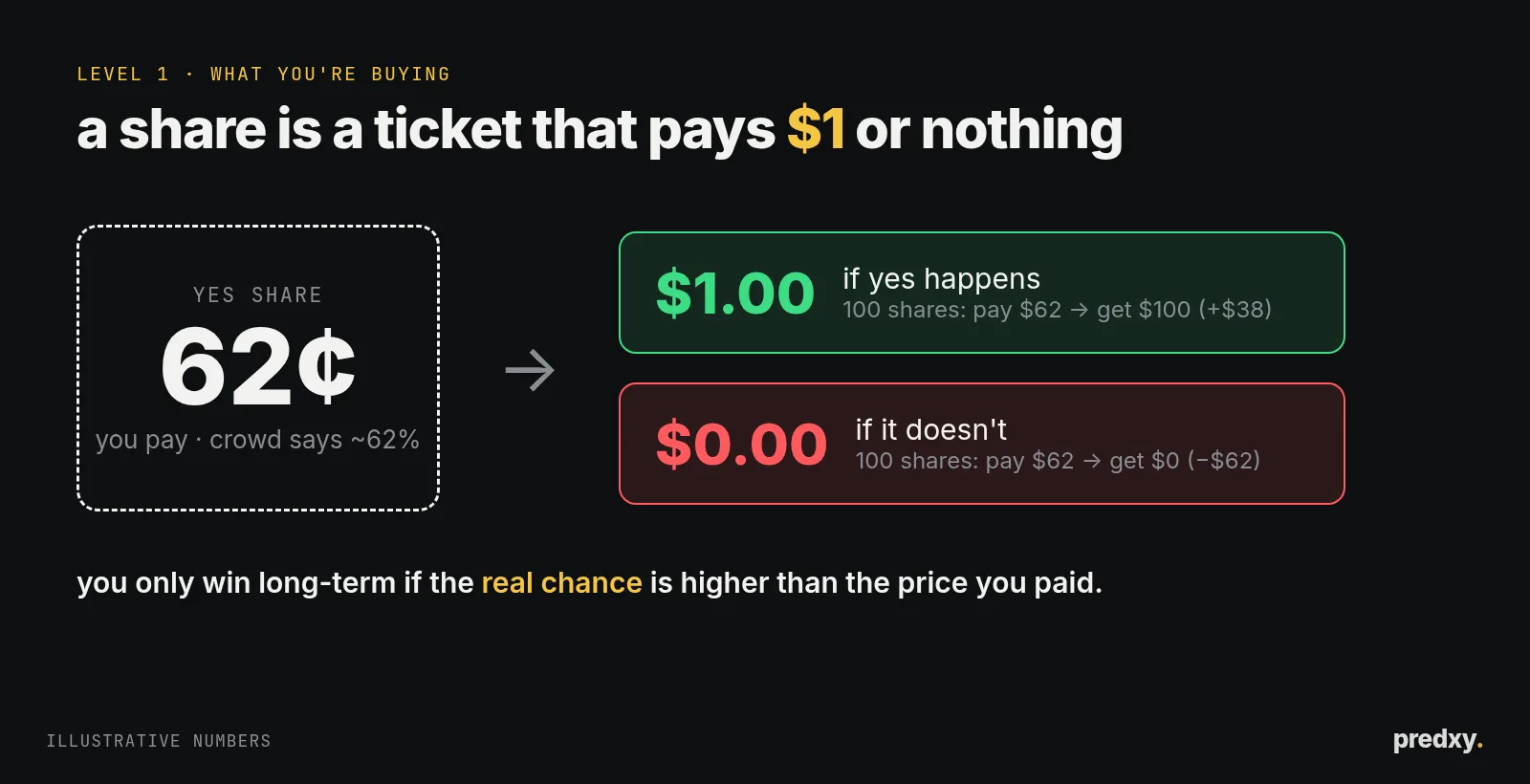
You buy 100 yes at 62¢. You pay $62. Right → you get $100. Profit $38. Wrong → you get $0. You lose $62.
 Credit:
A share pays $1 if you're right and $0 if you're wrong. (Illustrative numbers.)
You only make money if the real chance is higher than what you paid. Think it's 75% and you paid 62¢? Good deal. If it's really 50%? You overpaid. Everything else in this guide is about getting that comparison right.
Is a prediction market the same as a sportsbook?
No. At a sportsbook, the bookie sets the odds, keeps a cut built into them (the "vig"), and limits you if you win too much.
Polymarket and Kalshi don't work that way. They're peer-to-peer: every share you buy, another person sold. The app is more like eBay for opinions than a casino. Nobody sets the line. The price is just where the last buyer and seller agreed.
Hold onto that. It's why the strangest trades in this guide exist.
The big number on a market page feels like the answer. It's not. It's a summary of a list most people never open.
How to read a Polymarket order book
An order book is a line of people at a market stall
The order book is a list of everyone waiting to buy and everyone waiting to sell, and at what price.
Picture a market stall with no price tags, just two lists on the wall:
- Bids: "I'll buy at this price" (buyers, usually green)
- Asks: "I'll sell at this price" (sellers, usually red)
A trade happens when someone accepts a price from the other list.
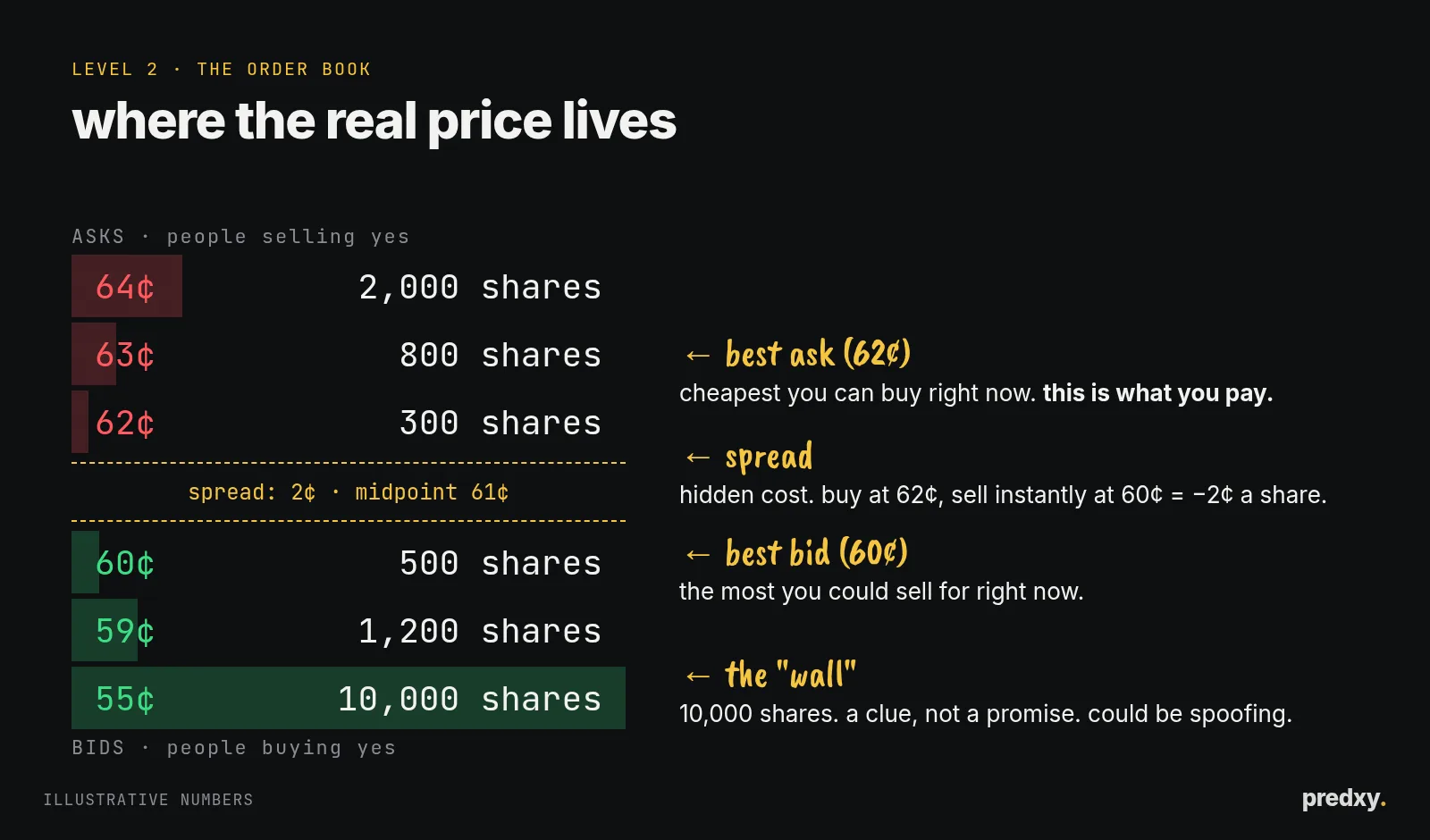
Here's an illustrative orderbook:
 Credit:
Best ask, best bid, the spread between them and a "wall".
Five things to read in an order book
1. The spread. The gap between the best ask (62¢) and the best bid (60¢).
It's a hidden cost. Buy at 62¢, change your mind a second later, and the best you can sell for is 60¢. You lost 2¢ a share doing nothing.
Tight spread (1–2¢) = busy market. Wide spread (10¢+) = nobody's home.
2. The headline price vs what you'll pay. The big number is usually the midpoint (here 61¢) or the last trade, which might be from three hours ago. Neither is what you'll pay. You pay the best ask.
3. Depth. How many shares sit at each price. Only 300 at 62¢. Want more? You're buying from the next seller up.
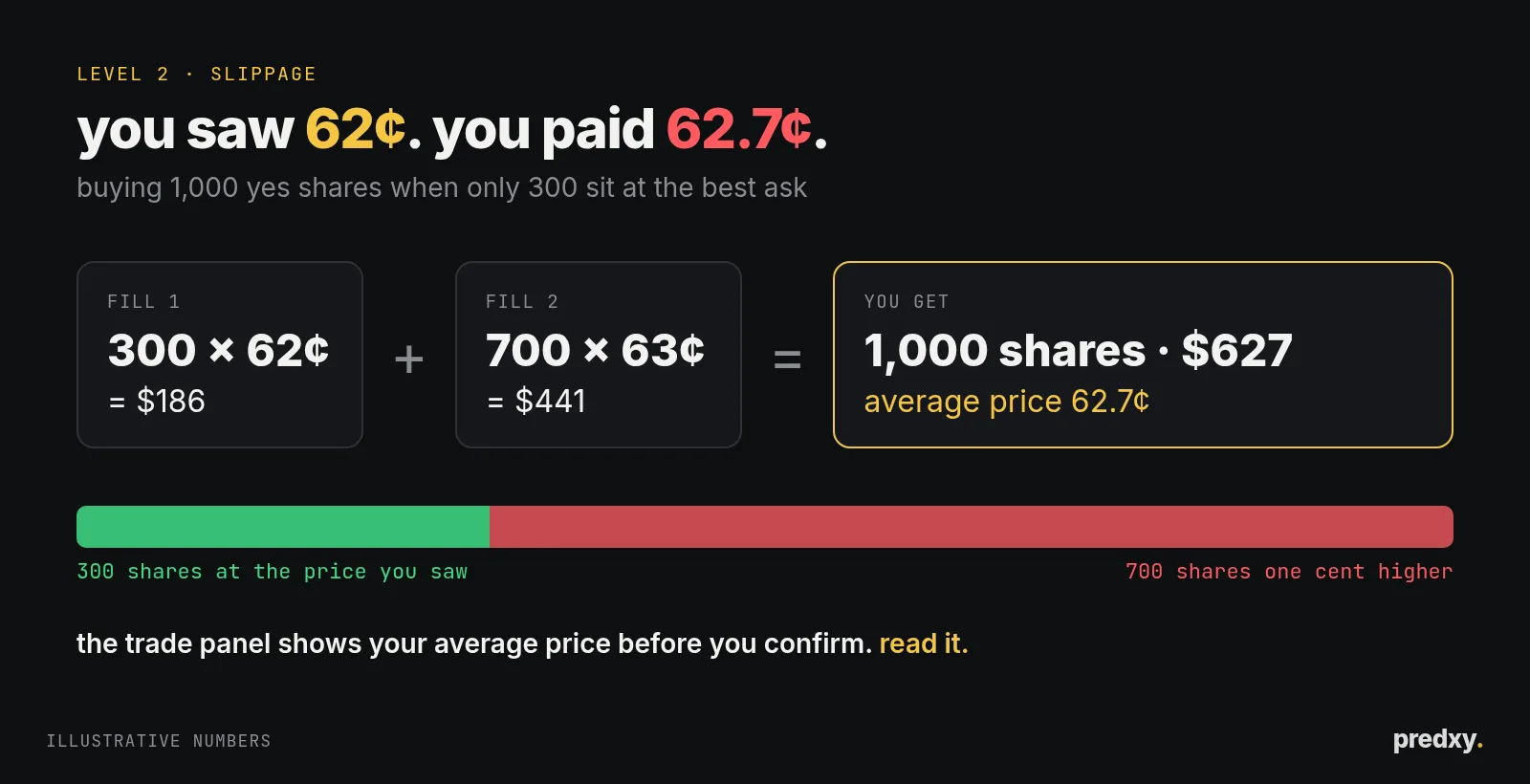
4. Slippage. What happens when you buy more than the top line holds. Say you want 1,000 shares:
300 at 62¢ = $186 700 at 63¢ = $441 1,000 shares for $627 → average 62.7¢
You saw 62¢ and paid 62.7¢. That's tiny on a small bet. On a big bet in a quiet market, it can eat your whole edge. The trade panel shows your average price before you confirm. Read it.
 Credit:
Buying more than the best ask holds pushes your average price up.
5. Walls. That 10,000-share order at 55¢ looks like someone huge saying "it won't go lower."
Maybe. Or it's bait. Some people place giant orders they never plan to fill, then pull them right before they'd get hit. That's spoofing. A wall is a clue, not a promise. If it vanishes as the price gets close, now you know.
Market orders vs limit orders
- Market order: "Give me shares now, at whatever sellers want." Fast. You pay the spread and any slippage.
- Limit order: "I'll buy at 61¢, not a cent more." You join the bid list and wait. You might not get filled, but you set the price.
On Polymarket, in categories that charge fees, only the person taking an order that was already waiting pays. The person who waited pays nothing and can earn rebates. Patience is literally cheaper.
Now you can read one market's book. Next question: is anyone actually here?
What do volume and open interest mean in a prediction market?
Volume = everything ever traded in this market. Think of turnstile clicks at a stadium.
Open interest = shares that still exist and haven't paid out yet. That's how many people are still inside the stadium.
- High volume + high open interest = lots of people holding real positions. A serious market.
- High volume + low open interest = lots of people flipping in and out, without much conviction.
- Low both = the price is one or two people's opinion. Trust it less.
Volume can lie, too. A few bots trading back and forth can pump it, and a market that was busy in March can be dead in October.
How to read a prediction market price chart
- Jumps: 40¢ to 70¢ in an hour means news. If you don't know why it moved, someone else does, and they're on the other side of your trade.
- Flat lines: no movement for days in a market that should be moving = stale price.
- The slide: near the deadline, prices drift toward 0¢ or $1. Time running out is information.
So far, everything here works the same in any market. The next part is where peer-to-peer markets get strange.
Should you buy at 99¢ or 1¢? Near-certain bets and longshots
Remember: no house.
That means prices go all the way to the edges. Some Polymarket markets let you trade in steps of 0.1¢ (a tenth of a cent). You'll see prices like 99.8¢ and 0.2¢.
A sportsbook will never sell you a 99.8% favorite at a fair price. It's not worth their time, and their cut would eat it. In a peer-to-peer market, someone will, because they have their own reasons: they want their cash back today to use somewhere else, they're hedging, or they're just done.
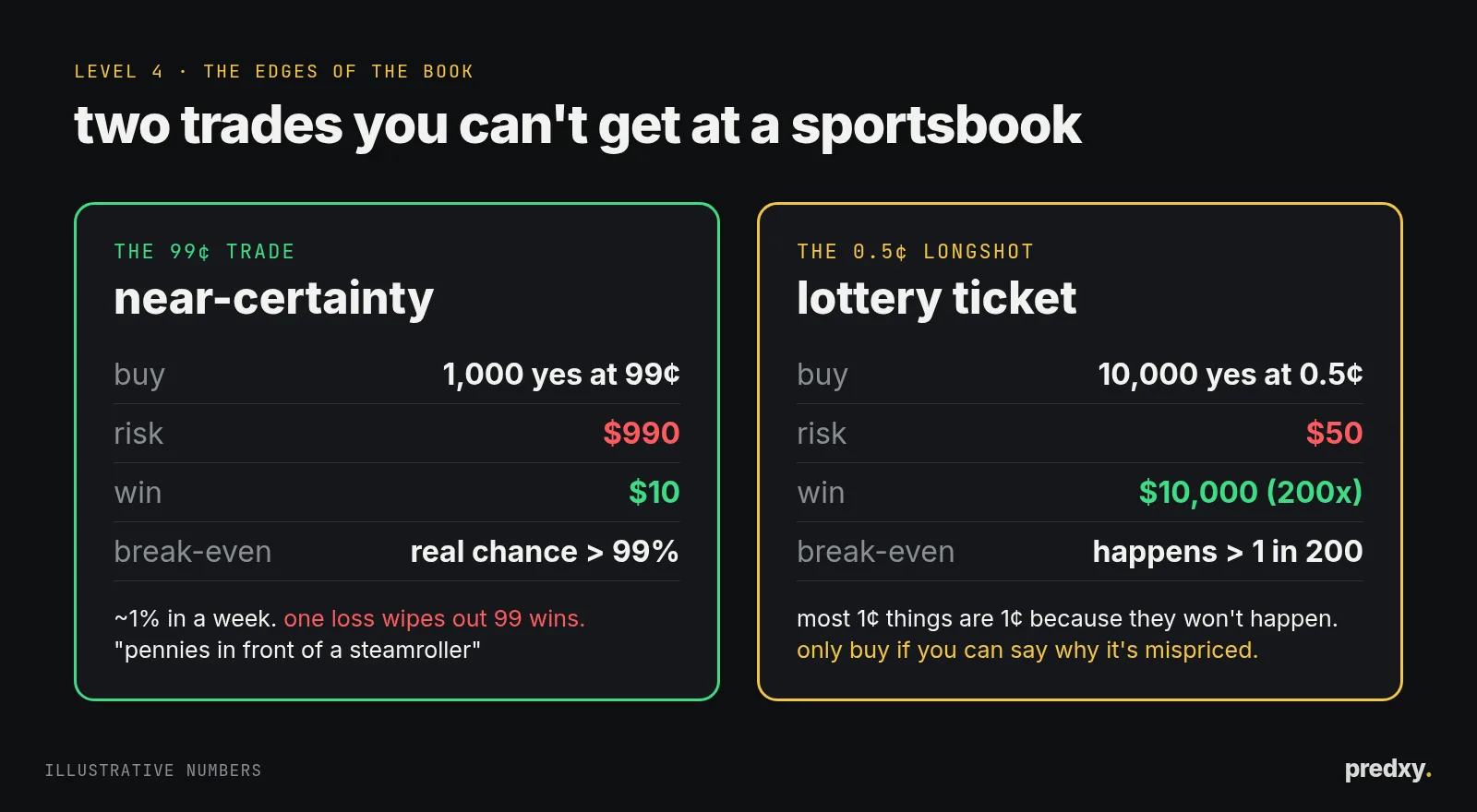
That creates two famous trades. One is a steady paycheck that sometimes explodes. The other is a lottery ticket that's sometimes underpriced.
 Credit:
The 99¢ trade: buying near-certainty
Something has basically happened. It's waiting to officially resolve. Yes trades at 99¢.
Buy 1,000 yes at 99¢ = $990 Resolves in 7 days → $1,000 Profit $10, about 1% in a week
1% a week, repeated, compounds to roughly 68% a year. That's why serious traders do this.
Fees barely touch it. Polymarket's taker fee is shares × rate × price × (1 − price). Near 99¢ that last part is almost zero: at a 0.04 rate, 1,000 shares at 99¢ costs about 40¢ in fees. Some categories have no fee at all.
Now the honest part. Traders call this picking up pennies in front of a steamroller.
You risk $990 to make $10. One loss wipes out 99 wins.
At 99¢ you only profit over time if the real chance is above 99%. If it's actually 98% because of a weird rule, a dispute or a surprise, the math flips:
Expected value = 0.98 × $1 − $0.99 = −1¢ a share
You lose slowly, then all at once.
This isn't hypothetical. In the suit market, menswear writer Derek Guy reportedly put about $3.6 million on no to win about $72,000, according to CoinDesk. That's a 2% return on a giant stake. The market resolved no, so the bet paid. But that's exactly the shape of this trade: huge risk, small reward, and the whole bet rests on how the rules get read.
Two more checks before any 99¢ trade:
- Return per day, not per trade. 1¢ in 2 days is great. 1¢ locked up for 4 months is worse than a savings account.
- Payout delay. Disputes can freeze your money for days or weeks.
The 1¢ longshot: when is it worth it?
Buy 10,000 shares at 0.5¢ = $50 It happens → $10,000 (200x) Break-even: it has to happen more than 1 time in 200
The honest truth: most things at 1¢ are at 1¢ because they won't happen. Across betting markets, longshots tend to be overpriced. People love a lottery ticket.
A longshot can be mispriced when:
- It's stuck at the floor. In a 30-candidate market, the no-hopers all sit at 1¢ because nobody bothers selling lower. That 1¢ means "minimum price," not "real 1%." Usually overpriced. Learn to spot it.
- There's lots of time left. "By end of year" at 1¢ in January isn't the same bet as in December.
- The rules make it likelier than it sounds. Ties, delays, technicalities.
- The book is stale. Someone left a 0.5¢ sell order weeks ago, the world changed, and nobody updated it.
A longshot is a good bet only when you can say exactly why the real chance beats the price. "It'd be funny" isn't a reason.
And the mirror: buying yes at 1¢ means someone else bought no at 99¢. Every longshot buyer is someone's steamroller. Know which side you're on.
Both trades come down to the same thing. Which brings us back to the suit.
How do prediction markets resolve? Why the rules decide who gets paid
Every market has a rules section. Most people never open it. It's the most common way people lose money on a bet they were "right" about.
 Credit:
Here's why the suit market went the way it did. On Polymarket, results get proposed and can be challenged. Disputes go to a vote by holders of a token called UMA, a decentralized "oracle" whose whole job is answering questions like this one. The suit market was disputed three times. Each time, more than 90% of the vote went against yes.
You can think that vote was wrong. Lots of people did. It doesn't matter. The market pays on how the question gets resolved, not on what you think happened.
Kalshi does it differently. It's a US-regulated exchange and settles its markets itself, using the source named in its rules. Different system, different risks. Neither is magic.
Read every rules section for four things:
1. What exactly counts. "Announced" isn't "happened." "A suit" is whatever the resolution process says it is. The market pays on the words, not on what you assumed they meant.
2. Who decides, and from what source. Which website, agency or outlet? What happens if it's slow, changes its data, or never reports?
3. The deadline, with a time zone. "By December 31": 11:59 pm Eastern? If it happens at 2 am on January 1 in Europe, did it count?
4. Edge cases. Ties, delays, cancellations, a candidate dropping out. Good rules spell them out. If they don't, you're carrying that risk.
A made-up example:
"Will company X launch product Y by March 31?" You buy yes at 80¢. The launch event is March 30. The rules say: "available for purchase to the general public in the US." It's a preorder. Shipping starts April 12. Resolves no. You called the news right and still lost.
Read the rules before the chart. Every time.
Why is the same market priced differently on Polymarket and Kalshi?
The same question often trades on several apps at once, and the prices don't always agree.
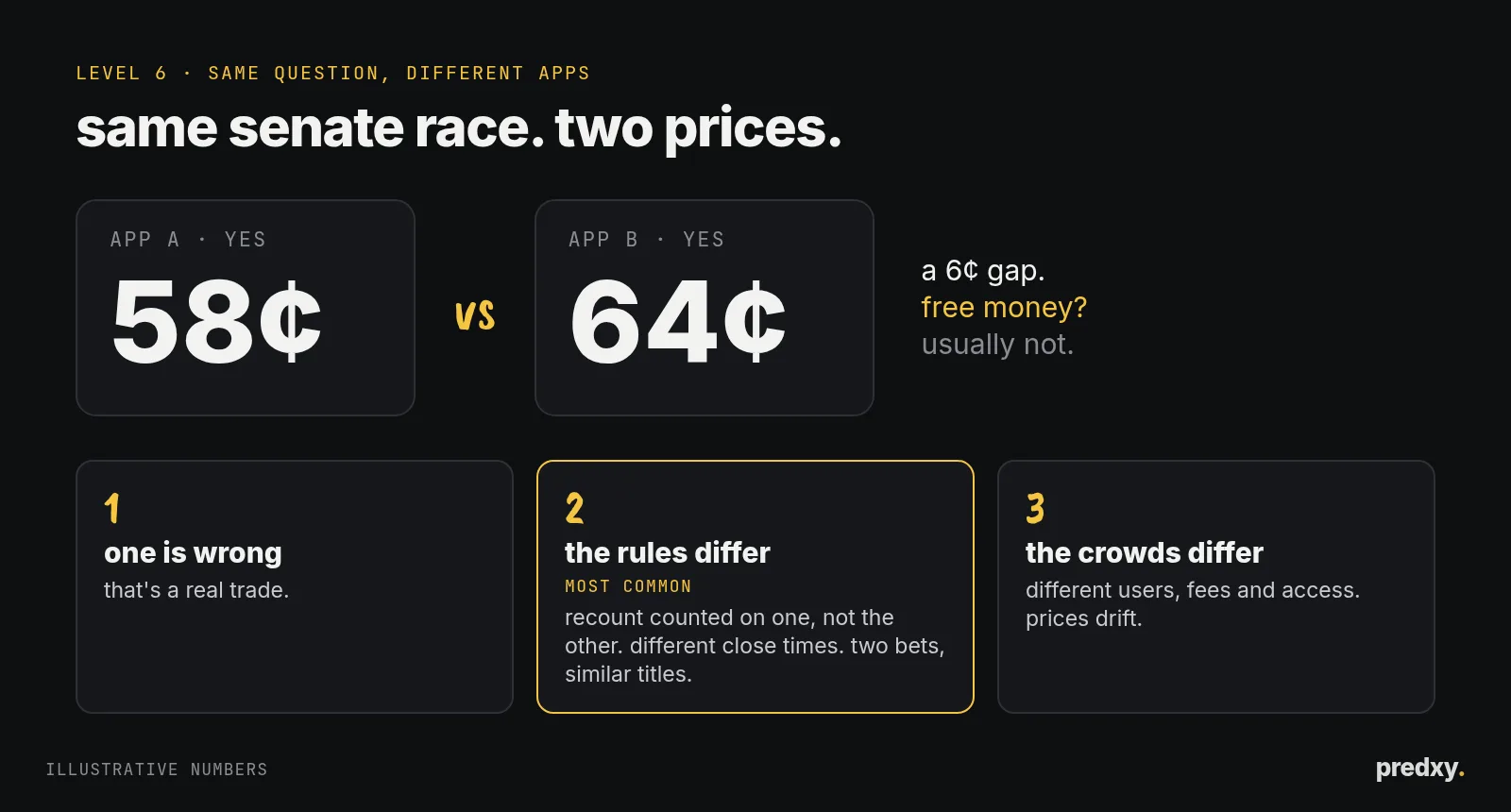
same Senate race: App A: 58¢ App B: 64¢
 Credit:
Three possible reasons:
- One of them is wrong. That's a trade.
- The rules are different. One counts a recount, one doesn't. One closes at midnight, one at noon. That's two different bets with similar titles.
- The crowds are different. Different users, fees and access. Prices drift apart.
Most "free money" between apps turns out to be reason 2. Compare the rules side by side before you touch it.
This is the problem we built Predxy for. It's one search across 400k+ questions on Polymarket, Kalshi and more, so you see the same question on every app in one place instead of nine open tabs.
What this guide won't do
It won't give you picks. Nothing here is a system that prints money.
The 99¢ trade loses sometimes. Most longshots are bad. Good reading only stops you from paying too much, buying a different question than you thought, or trading against someone who knows something you don't.
That's most of the edge, though.
Prediction market pre-trade checklist
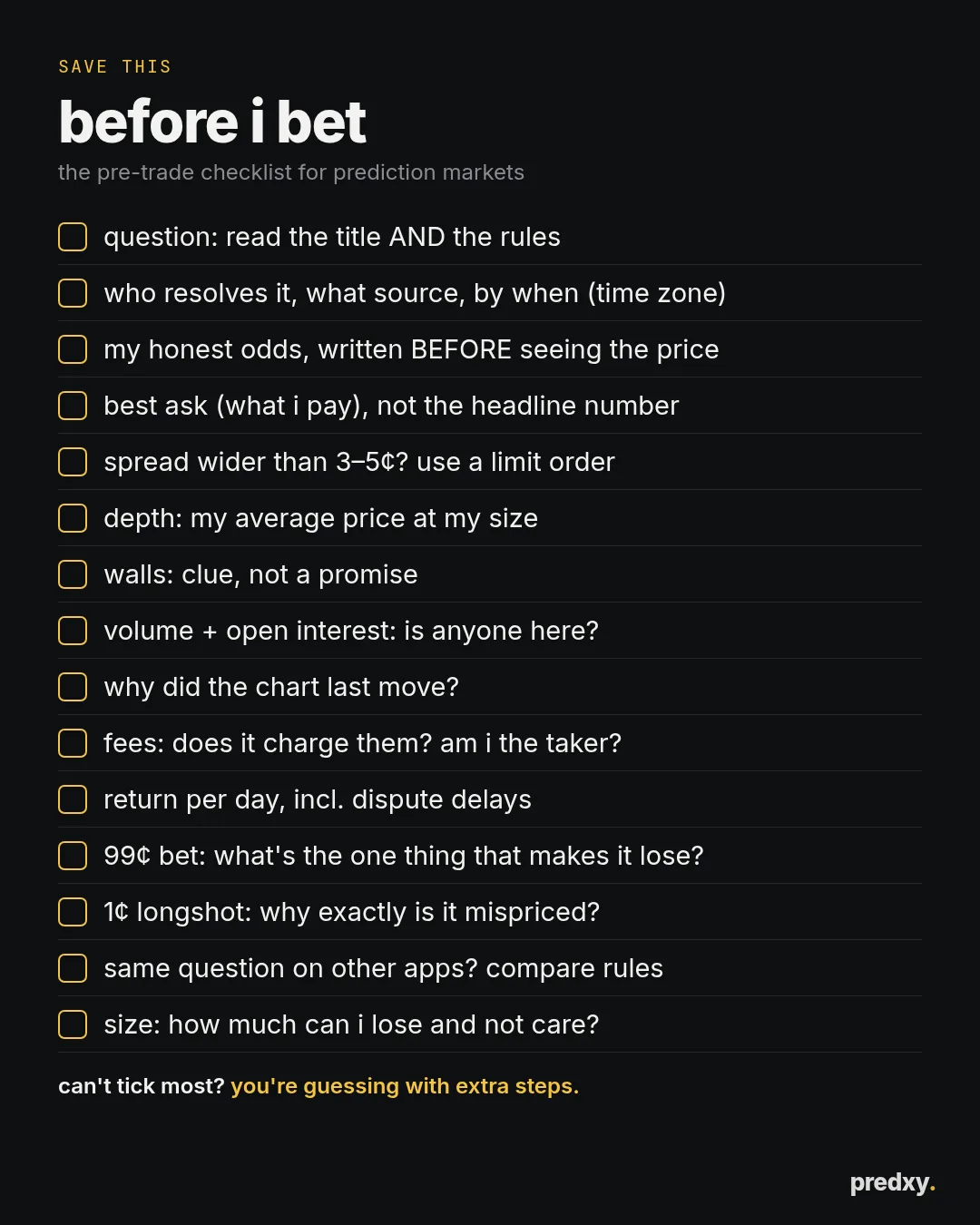
Save this card or copy the list into your notes:
 Credit:
Before I bet
- Question: read the title AND the rules, word for word
- Who resolves it, from what source, by when (time zone)?
- My honest odds, written down BEFORE staring at the price
- Best ask (what I actually pay), not the headline number
- Spread: wider than 3–5¢? Use a limit order
- Depth: what's my average price at my size?
- Walls: clue, not a promise
- Volume + open interest: is anyone actually here?
- Why did the chart last move?
- Fees: does this market charge them? Am I the taker?
- Return per day, including possible dispute delays
- 99¢ bet: what's the one thing that makes it lose?
- 1¢ longshot: why exactly is it mispriced?
- Same question on other apps? Compare the rules too
- Size: how much can I lose and not care?
Can't tick most of these? You're not trading. You're guessing with extra steps.
The short version
- A share pays $1 if right, $0 if wrong. The price in cents is the crowd's odds.
- No house. You trade against people, so prices go places a sportsbook never would.
- The headline number is a summary. The order book is the truth.
- 99¢ trades are steady until they aren't. 1¢ longshots are usually overpriced, unless you can say why they're not.
- The rules decide who gets paid. Not the news, not the photos, not you.
- Same question, different apps, different prices. Check the rules before calling it free money.
One thing to do today: open any market you're watching, find the spread, and read the full rules. It takes 3 minutes, and it's the habit that would have saved most of the people in the suit market.
Try Predxy search to see any question across Polymarket, Kalshi and more in one place, rules and prices side by side.
Want more breakdowns like this? Follow us on X (Twitter).
FAQ
What does a price of 62¢ mean on Polymarket?
It means the crowd puts the chance at roughly 62%. A winning share pays $1, so a 62¢ yes share returns $1 if the event happens and nothing if it doesn't. What you actually pay is the best ask in the order book, which can be higher than the headline number.
Is Polymarket a sportsbook?
No. Polymarket and Kalshi are peer-to-peer markets. Every share you buy was sold by another trader, and prices are set by buyers and sellers, not by a house that builds in a cut and limits winners.
Are 99¢ bets on prediction markets free money?
No. You risk 99¢ to make 1¢, so you only profit over time if the real chance is above 99%. One loss wipes out 99 wins. Disputes, rule wording and payout delays are where these trades go wrong.
How are Polymarket markets resolved?
An outcome is proposed and can be challenged. Disputed outcomes go to a vote by UMA token holders, and the market pays on that result, even when people disagree with it. Kalshi settles markets itself, using the source named in each market's rules.
Why do Polymarket and Kalshi show different prices for the same event?
Usually because the rules differ: a different deadline, source or treatment of edge cases makes them different bets. Sometimes one price is simply wrong, or the two apps have different traders. Compare the rules before treating a gap as free money.
Not financial advice. Just how we read markets. Size small, read the rules.